Regulatory
Clear pathImport is not the constraint.
No HSA pre-market approval or importer licence for a qualifying health supplement. About 3–6 weeks once the formula and Singapore labels are settled.
Rejuvant Professional
Preliminary · Private and confidential
Rejuvant Professional is a 2,000 mg controlled-release calcium alpha-ketoglutarate (Ca-AKG) supplement from Ponce De Leon Health (PDLH). Bringing it in is light-touch. Marketing it is not: the benefit it is known for, a lower biological age, is an anti-ageing claim HSA does not allow on any supplement.
Import lead time
3–6 weeksNo HSA pre-market approval needed
Human studies
2Both on consumer Rejuvant at 1,000 mg, no placebo
Placebo-controlled trial
PendingABLE, NUS; finished main data collection Aug 2025
"akg supplement" searches
140/mo−47% year on year, vs 4,400 for NMN
Sources: internal regulatory assessment; study papers; ClinicalTrials.gov NCT05706389; Google Ads Keyword Planner, Singapore, Sep 2025 – Aug 2026.
Regulatory
Clear pathImport is not the constraint.
No HSA pre-market approval or importer licence for a qualifying health supplement. About 3–6 weeks once the formula and Singapore labels are settled.
Evidence
EarlyThe human evidence is early.
Two studies, both on consumer Rejuvant at 1,000 mg, no placebo group, both with manufacturer-linked authors. The placebo-controlled ABLE trial has not reported.
Claims
Restricted"Health supplement" is the only angle.
Biological age, anti-ageing and skin-ageing claims are prohibited. Doctor recommendations cannot appear in supplement ads.
Demand
SmallSearch demand is small and falling.
About 140 searches a month for "akg supplement" (−47%), against 4,400 for "nmn supplement" (+22%).
Go to market
MixedSelling in consult works; acquisition is harder.
Easy to add to existing SLAC patients' regimens. To bring in new patients it needs a service around it, which carries its own risks.
Front brand
SLAC. PLMC and PWW fit the longevity theme better, but SLAC has the customer base and brand equity to launch a new product.
Base case
Sell to existing patients in consult. Supplement advertising rules do not cover one-to-one advice. Easiest route; assumed throughout.
Objective
New-patient acquisition for SLAC. The rest of this report tests whether Rejuvant can do that job.
Market
Singapore first. Malaysia needs separate registration and possibly a reformulated product.
Section 1 · Evidence
Rejuvant's case rests on DNA methylation ("epigenetic") clocks, which estimate biological age from a saliva sample. Four human studies are relevant to the product.
Aging · consumer Rejuvant, 1,000 mg
−8 years
Biological age after about 7 months on the TruAge test. Retrospective, open-label, before and after, no placebo. 42 people.
Aging Cell · consumer Rejuvant
−1.8 years
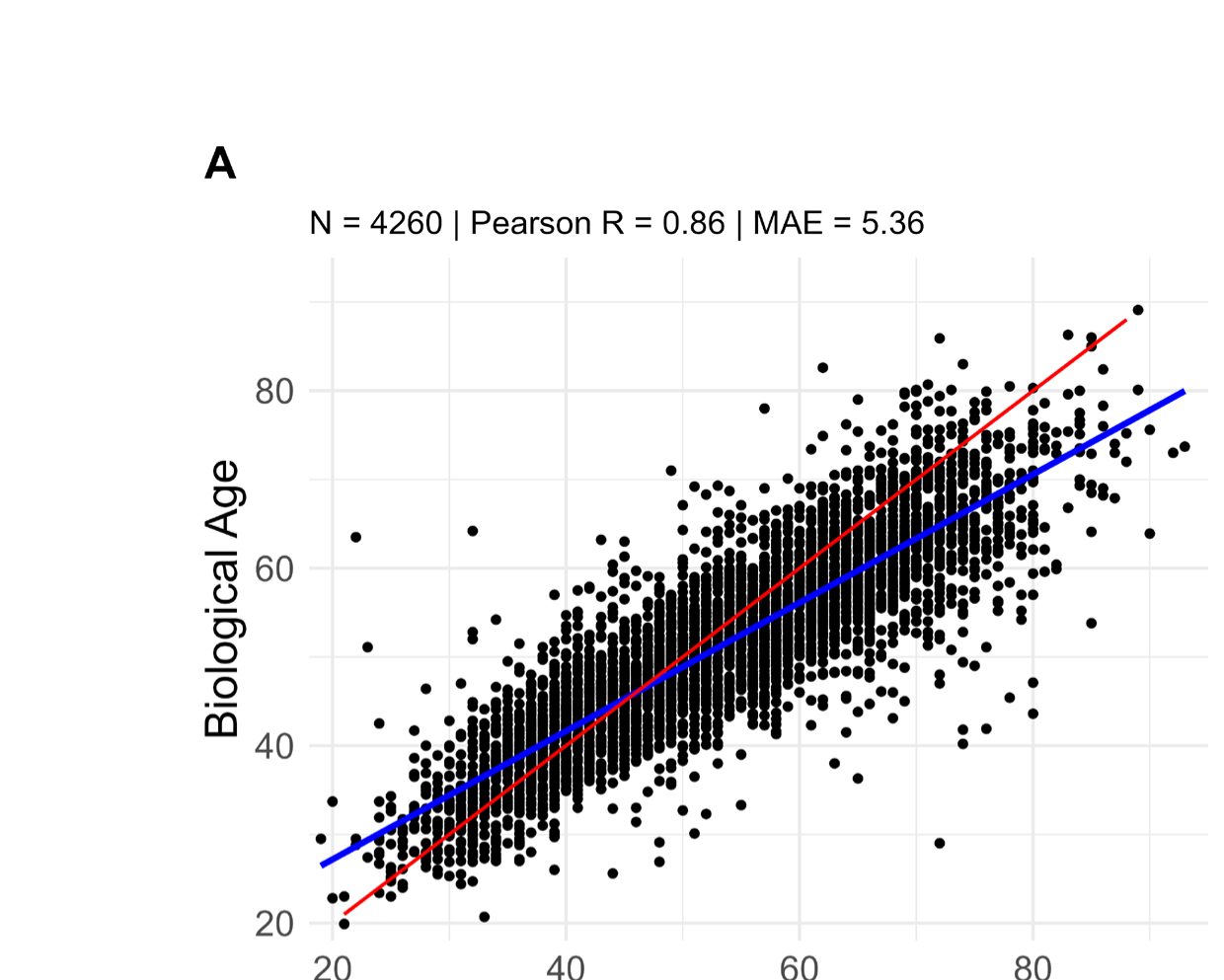
Users younger than predicted after adjustment; regular AKG not significant. Cross-sectional, observational. 4,260 people.
NCT05706389 · 1 g sustained-release Ca-AKG
n/a
Randomised, double-blind, placebo-controlled; 120 planned. Primary completion Aug 2025; study completion estimated Jan 2027.
AKG at 0.2 g/kg a day, about 14 g
4 weeks
Better training volume, power and recovery scores than placebo. Randomised, placebo-controlled. 33 young men.
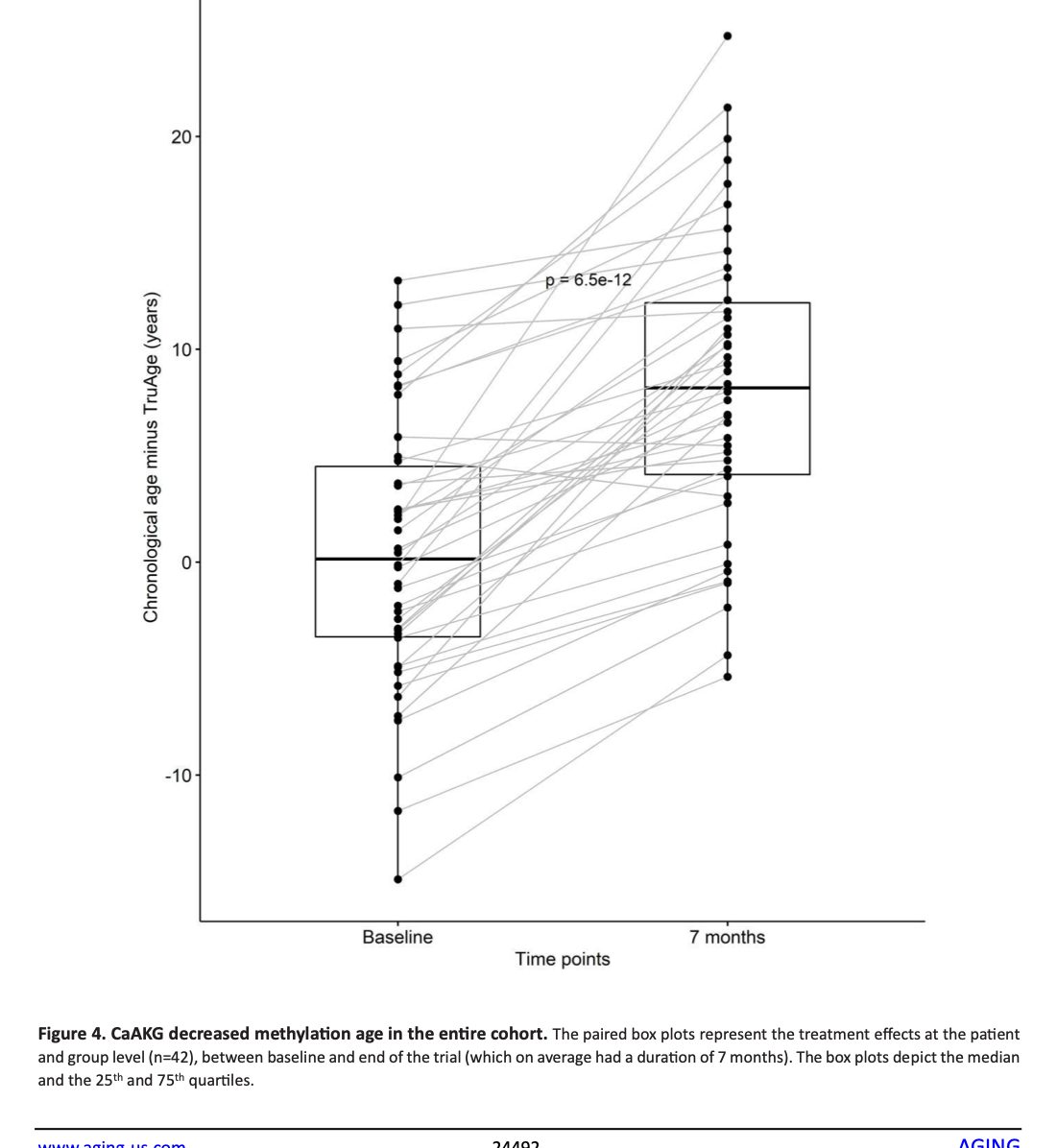
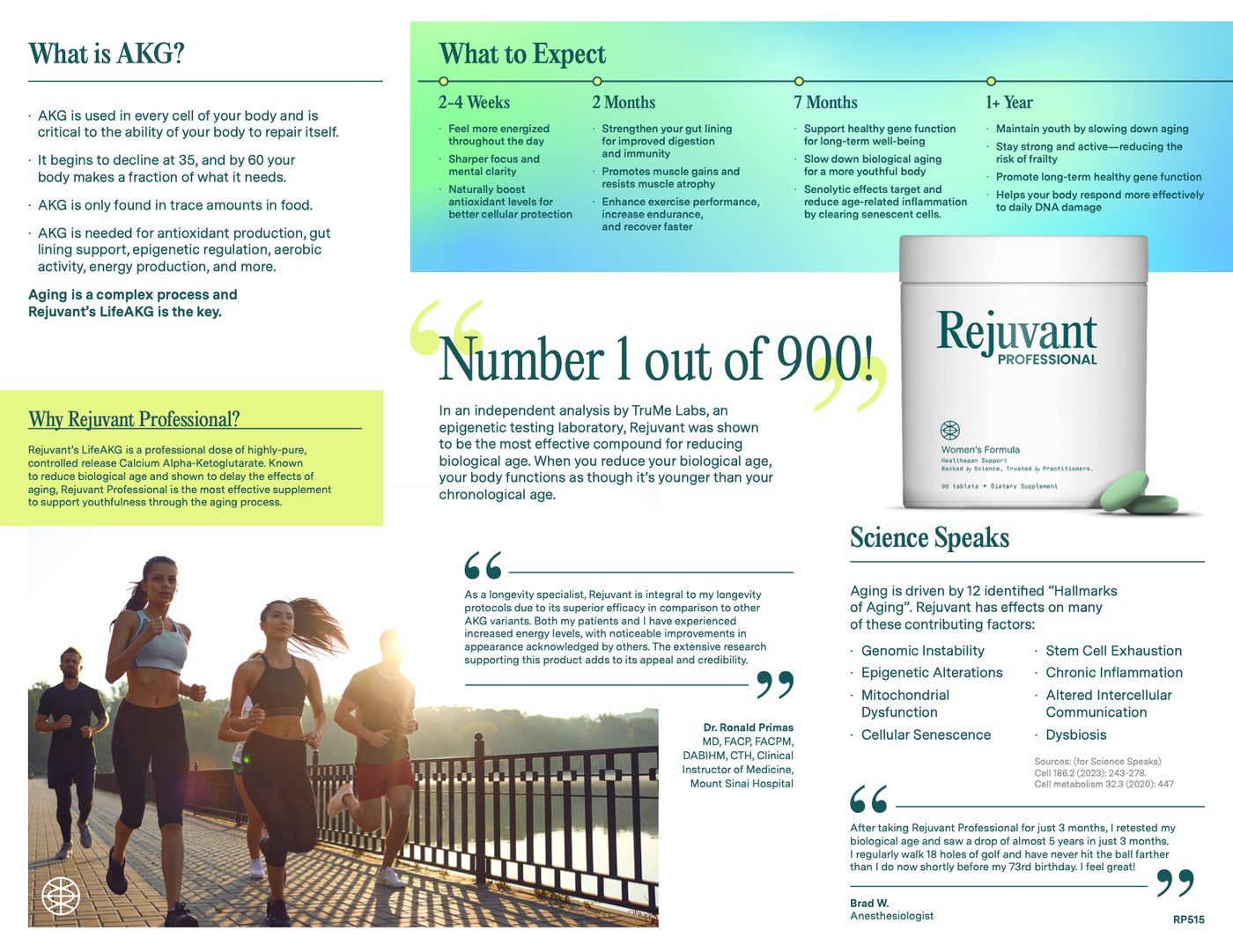
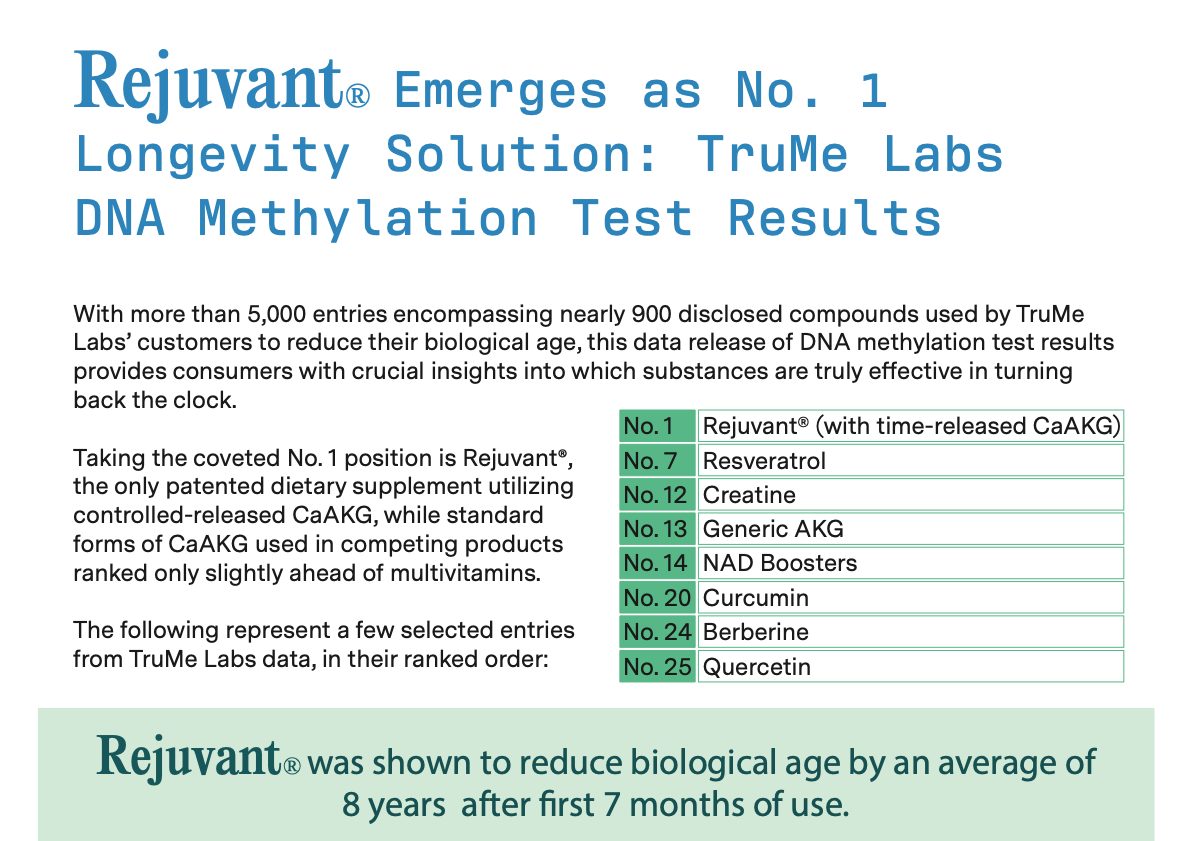
The 2021 study used data from PDLH customers. Two co-authors are from PDLH, and the testing lab (TruMe) had a service agreement with PDLH. Prof Brian Kennedy co-authored both studies and is senior author of the 2026 paper. He is a scientific advisor and board member of PDLH, which the 2026 paper discloses in its acknowledgements. A TruMe scientist co-authored it. PDLH sponsored the mouse lifespan study behind the product. The brochure's "No. 1 out of 900" ranking comes from TruMe customer data.
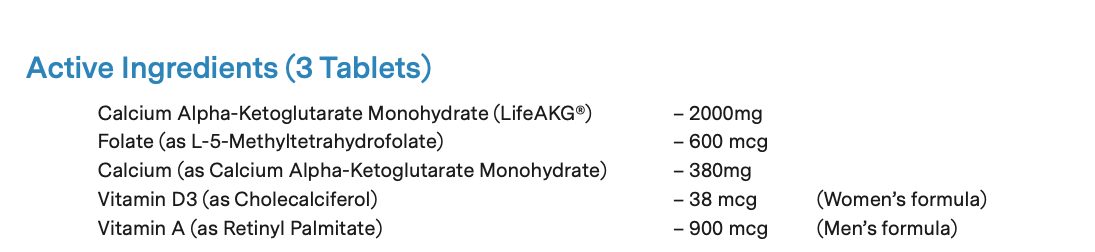
Both human studies used the consumer product at 1,000 mg, and so does ABLE. The Professional data sheet applies the 8-year result to its 2,000 mg formula. The 2021 authors note there is "very little data" on higher doses. No study compares 2 g with 1 g.
Participants chose how long to take the product and when to retest. Only 13 of the 42 reported no change to diet, exercise, sleep, drinking or other supplements. The largest drops were among people who started biologically older. Without a control group, that pattern can also come from regression to the mean.
The 1.8-year effect was measured with a clock whose average error is 5.4 years. In the subset tested more than once, the association was not significant after correction. In PDLH's press release, Prof Kennedy quotes users as "5.74 years younger". That is the raw gap between users' biological and chronological age, not a comparison with non-users.
Apart from the exercise trial, muscle, bone and lifespan findings come from mice, worms or cell culture. The exercise trial dosed about 7× the Professional serving. Skin evidence comes only from topical AKG and cell or mouse models; no human study has tested oral AKG on wrinkles or collagen. ABLE measures skin autofluorescence, a marker of glycation, not wrinkles. The folder's two other papers are also preclinical: synaptic plasticity in a mouse model (Navakkode et al., 2025) and intestinal stem cells in mice (Andersson et al., 2025).
Decision point
ABLE decides the evidence case. It is the only placebo-controlled test of this ingredient and dose form, and it runs in Singapore. A positive result is the strongest local proof point available; a null result removes the case. Ask Prof Kennedy's group when results are expected before committing stock.
Section 2 · Regulatory
A qualifying health supplement needs no HSA pre-market approval or dealer licence. The importer still owns safety, quality, labelling and claims. Assessment: conditional go for due diligence.
Classification and formula review
Full formula, variants, dosing; HSA classification tool
3–7 working days
Supplier quality dossier
Certificates of analysis, GMP, stability, adverse events
1–2 weeks
Singapore labels and claims
Pack, leaflet, website, doctor and clinic materials
1–2 weeks
Customs setup
UEN, Customs Account, declaring agent, HS code
4 hours to 3 working days
Import and release
TradeNet permit (about SGD 3.19), GST, batch records
Shipping-dependent
Overall working estimate 3–6 weeks with existing inventory and parallel review; not an HSA commitment. Sources: HSA; Singapore Customs; internal regulatory assessment.
Not allowed
Allowed
Clinic channel
Selling through SLAC brings in Healthcare Services Act advertising rules and the SMC's guidelines on doctors selling health products, on top of HSA's rules.
Vitamin limits
The women's formula has 38 mcg of vitamin D3, about 1,520 IU. Malaysia caps it at 1,000 IU. HSA's limits still need confirming against the full formula.
Malaysia
Supplements need NPRA product registration (a MAL number), a much longer process than Singapore's.
Name and pack
HSA treats names and pack text as claims. The US pack says "Promotes Healthy Biological Aging", so Singapore labels are likely. That affects MOQ and lead time.
Coming changes
HSA consulted in Jul 2026 on a new framework that could make notification mandatory, with controls moving under the Health Products Act by end-2028.
Gate A · Regulatory
Full formula, classification, permitted ingredients and limits, revised labels and claims.
Marketing / regulatory with supplier
Gate B · Clinical
Finished-product evidence, safety review, dosing and patient selection.
Medical lead
Gate C · Commercial
Distribution rights, cost model, MOQ, expiry, recall terms, first-order proposal.
Business development, finance, operations
No purchase order, final claims, doctor-endorsed promotion or launch date until gates A–C are complete.
Section 3 · Market
Consumer Rejuvant (LifeTabs), late 2021 to about 2023
Source: Google Ads Keyword Planner, Singapore, Sep 2025 – Aug 2026. Close variants share one volume and are not additive. Top-of-page bids: "akg supplement" SGD 0.42–2.48; "rejuvant" SGD 2.33–8.20.
| Product | Type | Where sold | Price seen |
|---|---|---|---|
| ProHealth Longevity Calcium AKG | Ca-AKG, 1,000 mg a serving | iHerb SG | SGD 37.80 / 60 caps |
| Xandro Calcium AKG | Ca-AKG, 500 mg a capsule | Robinsons, Lazada, Shopee | SGD 47.20 |
| Codeage Liposomal Calcium AKG | Ca-AKG, liposomal | iHerb SG | SGD 43.17 / 60 caps |
| Tru Niagen | NR (NAD+ booster) | Watsons SG and MY | SGD 92 / 30 caps |
| GreenLife NMN Boost | NMN blend | Woods Pharmacy, Shopee, Lazada | SGD 79.90 / 30 |
Regular prices observed in Oct 2026. In Malaysia, Watsons also carries NMN blends with beauty positioning (Yukazan, MegaLive). IV NAD+ clinics compete for the same longevity spend. No competitor was found that requires a practitioner to supply it.
Section 4
AKG terms total a few hundred searches a month and are falling. Searchers compare products they can buy online today. A consult is an extra step no competitor asks for.
No biological age, anti-ageing or doctor endorsement, and no "prescribed", since it is a supplement. "Higher dose than OTC AKG" is a comparative claim with no study behind it. Consumer buyers can also take two tablets.
It is a slice of the searches above. Most users cannot tell whether AKG worked without a paid epigenetic test.
Baseline test
Saliva epigenetic test
Doctor review
SLAC consult
6 months
Rejuvant Professional
Retest
Same test, same lab
What it solves
The outcome becomes measurable, and the advertised offer becomes a clinic service, not a supplement. It gives new patients a reason to book.
Why it only half-solves visibility
The 2026 study's clock has an average error of 5.4 years, against a 1.8-year average effect. Many paying patients would retest the same or "older". That is a complaint and refund risk. Results would also still be off-limits for advertising.
Section 5 · For consideration
Section 4's biological age programme needs a baseline test, a doctor review and a retest. PLMC already sells most of that. Its Longevity Blueprint is a doctor-led screening built on AgeQ, and PLMC is a listed AgeQ provider. Adding Rejuvant to the plan that follows the screening would join the three into one pathway across the Prologue brands.
Test
Blood-based biological age · AgeQuotient / Lucence
Biological age from seven routine blood markers (fasting glucose, albumin, creatinine, red blood cells, basophils, neutrophils, monocytes), with age and sex. Developed with NUS, A*STAR and HKUST on data from more than 300,000 people in Singapore, the US and the UK. Marketed as the first biological age score built on Asian health outcomes.
Programme
PLMC · SGD 169
AgeQ test, hand-grip strength test, InBody body-composition scan and a personalised treatment plan from a doctor consult. Under 45 minutes, with results in 4–6 days and a review to set an action plan.
Supplement
2,000 mg Ca-AKG · health supplement
The plan item after screening, recommended in consult. Follow-up Blueprints at six and twelve months would give the repeat visit and the measurable outcome that a supplement on its own lacks.
Entry
SLAC patient base and campaigns
Blueprint
AgeQ, grip, InBody at PLMC
Doctor plan
Rejuvant plus lifestyle actions
Maintenance
Refills and wellness services, PWW
Retest
Blueprint at 6 and 12 months
Pathway sketch for discussion. PWW's role here (refills and wellness services) is a suggestion and has not been checked against its current offering.
Why it fits
What to resolve first
Sources: prologueclinic.com Longevity Blueprint page and knowyourageq.com, both accessed 12 Oct 2026; NCT05706389 for ABLE's secondary outcomes.
| Question | Why it matters |
|---|---|
| When will ABLE report, and what did it find? | The only placebo-controlled evidence; it decides the evidence case. |
| Why did Regenosis stop? | It ran a specialist-guided model close to ours, with strong PR. |
| Does PDLH restrict the Professional formula to practitioners in Singapore, and can we hold exclusive rights? | Without enforced restriction, "Professional" is not a moat. |
| Can consumers already buy consumer Rejuvant from Singapore? | rejuvant.com lists USD 99.95–129.95 a pack; shipping to Singapore is unconfirmed. |
| What are the landed cost, MOQ and shelf life on arrival? | Sets the retail price against SGD 38–47 a pack for OTC Ca-AKG. |
| Does the full formula meet HSA limits, and will PDLH supply Singapore labels? | Gate A; affects lead time and minimum order. |
| How variable is AgeQ on retest, and has any supplement been shown to move it? | Decides whether the PLMC pathway can promise a measurable change. |
| How would SLAC refer patients into PLMC's Blueprint, and which brand books the revenue? | Needed before the cross-brand pathway can run. |